The Six Worldly Councils: Explained by Dhammarato
Across the six general councils (saṅgīti, literally “reciting together”), the preservation of the Buddha’s teachings repeatedly collided with human attachment to rules, wealth, political turmoil, and the belief in continuing existence.
| Council | Approximate Date | Location | Key Figures & Patrons | Catalyst | Core Focus & Outcome |
|---|---|---|---|---|---|
| First Council | c. 486 BCE (Traditional) / c. 406 BCE (Modern research) | Rājagaha (Rajgir, India) | Mahākassapa, Ānanda, Upāli, 500 Arahants | The Buddha’s death and a monk’s remark celebrating freedom from monastic rules | Oral recitation and standardisation of the Dhamma (Suttas) and Vinaya over 3 months |
| Second Council | c. 386 / 306 BCE (100 years after the First) | Vesālī (India) | Senior Vinaya elders | Dispute over whether accepting small coins violated the precept against gold and silver | Debated monastic discipline (Vinaya); Dhammarato notes no rules were changed |
| Third Council | c. 250 BCE | Pāṭaliputta (Patna, near Rājagaha) | Emperor Ashoka, orthodox Arahants | Mass ordination of 20,000 to 50,000 non-Buddhists seeking free food, robes, and lodging | Entrance exam used to filter imposters; excluded monks formed the Mahāsaṅgha |
| Fourth Council | 1st Century BCE (c. 30 BCE) | Āluvihāra (Sri Lanka) | Sri Lankan Sangha | Warfare in Sri Lanka threatening the survival of the oral tradition | The Tipiṭaka was committed to writing on palm leaves |
| Fifth Council | 1868–1871 CE | Mandalay (Burma / Myanmar) | King Mindon, 500 Burmese monks | Colonial pressure and regional wars in the 1860s | The Pali Tipiṭaka (in Burmese script) was chiselled into 750+ marble tablets and verified over 2 years |
| Sixth Council | 1954–1956 CE | Rangoon / Yangon (Burma / Myanmar) | Mahāsi Sayādaw, Mingun Sayādaw, Bhikkhu Buddhadāsa | Post-WWII turmoil and ongoing civil war in Burma | International collaboration of 8 countries to recite and verify the Tipiṭaka; rebirth remained debated |
Pre-Council Context: The Last Days of the Buddha
Before examining the First Council, Dhammarato frames the underlying tension of Buddhist history through events recorded in DN 16 (Mahāparinibbāna Sutta) and MN 38 (Mahātaṇhāsaṅkhaya Sutta):
- Ānanda’s Subtle Confusion: Three months before passing away, the Buddha expressed dissatisfaction with his half-brother (cousin) and longtime attendant, Ānanda. Although Ānanda had served the Buddha for 25 years and possessed a phenomenal memory, he had not yet attained Arahantship. In DN 16, the Buddha drops repeated hints that one who has developed the four bases of psychic power (iddhipāda) could remain for the rest of the lifespan, which Ānanda fails to grasp.
- The Belief in Continuing Existence: Dhammarato notes that Ānanda remained stuck in the subtle belief in “continuing existence” (bhava), or the sense that “I am Ānanda” continuing into the future. Dhammarato links this to MN 38, where Sāti, the fisherman’s son, claimed that consciousness wanders and transmigrates to experience the results of past deeds. The Buddha rebuked Sāti on the spot as a “foolish man” (moghamapurisa, transcribed as “Marga, son of an idiot”) without a shred of wisdom, teaching instead that consciousness arises dependently through present conditions.
- The Buddha’s Passing (Parinibbāna): At age 80, the Buddha ate a final meal offered by Cunda the metalworker containing sūkaramaddava (which Dhammarato notes appears only once in the suttas and is often speculated to be mushrooms, while translators note it refers either to a mushroom dish or tender pork). The Buddha fell gravely ill for three days before dying in Kusinārā, explicitly instructing Ānanda that Cunda should not be blamed for his death.
1. The First Council (c. 486 BCE traditional / c. 406 BCE modern research)
- Pre-Council Context and the Buddha’s Passing: Three months before dying at age 80, the Buddha voiced dissatisfaction with his longtime attendant (and younger half-brother/cousin) Ānanda. Although Ānanda had a phenomenal memory, had served 20 years as an elected politician before striking a deal to be the Buddha’s permanent attendant, and double-checked everything Sāriputta taught him directly with the Buddha, he missed the Buddha’s repeated hints that his life was coming to an end. The Buddha finally stated directly that he was going to die, and later passed away three days after eating a final meal (often speculated to be mushrooms, as the Pali word appears only once in the suttas), while instructing the monks not to blame the cook or server because his death was simply due to circumstances.
- The Catalyst: Immediately after the Buddha died, a monk went around celebrating that they were finally out from “under the thumb of the Buddha” and no longer had to follow his rules. Mahākassapa strongly disagreed and convened the First Council of “500” Arahants (a Pali idiom denoting a large, uncountable group rather than an exact number) to finalise the teachings so the Dhamma would not become diluted or “willy-nilly” in the future.
- Ānanda’s Deficiency and Overnight Awakening: Mahākassapa initially banned Ānanda from the council because he was not yet an Arahant, still clinging to a subtle belief in “continuing existence” (the selfish notion of “I am Ānanda” persisting into the future, linked to rebirth). Desperate to enter the council, Ānanda practised all night intensely without success, finally gave up to go to bed, and right at the moment of letting go realised the truth, becoming an Arahant just in time to be admitted.
- Proceedings and Outcome: For three months, the council focused on establishing what the Dhamma is. Mahākassapa questioned Ānanda, who recited the discourses from memory, establishing the Majjhima Nikāya, the Saṁyutta Nikāya, and much of the Aṅguttara Nikāya (which Dhammarato notes suffered from later additions and textual tampering).
- Sutta and Canonical Cross-References:
- DN 16 (Mahāparinibbānasutta) and Vinaya Kd 21 (Pañcasatikakkhandhaka) corroborate the Buddha surrendering his life force three months prior at the Cāpāla Shrine after Ānanda failed to pick up his hints, his final meal of sūkaramaddava (translated variously as mushrooms/truffles or tender pork) offered by Cunda the metalworker, and the old monk Subhadda celebrating the Buddha’s death as an excuse to abandon the rules, which directly motivated Mahākassapa to convene the First Council at Rājagaha.
- MN 108 (Gopakamoggallānasutta) and DN 33 (Saṅgītisutta) explain that because the Buddha appointed no successor to rule the Saṅgha, the community relied on consensus and communal recitation (“reciting in concert” without dispute, modelled by Sāriputta in DN 33), with Mahākassapa leading the First Council, Ānanda reciting the Suttas, and Upāli reciting the Vinaya.
- MN 38 (Mahātaṇhāsaṅkhayasutta) (transcribed as “Mahatanha Vibhavana Sutta”) is cited by Dhammarato to illustrate the error of continuing existence: in it, the Buddha rebukes Sāti, the fisherman’s son (“a fishy belief system”), as a foolish man (moghapurisa) for claiming that consciousness wanders from life to life experiencing the results of past deeds.
- DN 33, AN 7.8 (Saṁyojanasutta), and AN 3.80 (Cūḷanikāsutta) confirm that “desire for continued existence” (bhavarāga) is one of the seven fetters binding a practitioner until Arahantship, while in AN 3.80 the Buddha defends Ānanda and predicts he will attain full extinguishment in this very life.
2. The Second Council (c. 386 BCE / c. 306 BCE, ~100 years later)
- The Catalyst and Core Controversy: Convened roughly a century after the First Council, the Second Council shifted focus from the Dhamma to the Vinaya (monastic rules and their application). The central dispute revolved around money, specifically whether the precept against accepting gold and silver (jātarūpa-rajata) forbade monks from accepting small everyday coinage.
- Dhammarato’s Linguistic and Historical Analysis: Pointing out that archaeological digs from that era reveal coins made of copper, tin, brass, or brass-covered wood rather than precious metals, Dhammarato explains that jātarūpa (silver, root of “rupee”) and rajata (or Thai thong, gold) referred to bullion. He notes that the Buddha opposed the accumulation of genuine wealth (bullion, land, cattle, goats, sheep, servants, and slaves), not petty change. He illustrates how this debate persists today with two Thai anecdotes: receiving a traditional birthday offering of 47 baht (~$1.50) in coins at Wat Cholapratan in Nonthaburi, and a famous Bangkok monk who died with bags of birthday alms stacked along his kuti walls totalling under 20,000 baht (~$600), sparking a national newspaper scandal until people realised how small the amount actually was.
- Proceedings and Outcome: In Dhammarato’s telling, the Second Council ended in a complete stalemate (“a hilarious joke”) because the monks could not agree on how much money was too much, leaving the Vinaya completely unchanged from the time of the Buddha.
- Sutta and Canonical Cross-References:
- Vinaya Kd 22 (Sattasatikakkhandhaka) and Bu NP 18 record the Second Council at Vesālī as a confrontation between “rigorists” (monks from Pāvā, Avanti, and the south) and “laxists” (monks from Vesālī) over ten points of discipline, the foremost being the acceptance of money (jātarūparajata, defined in Nissaggiya Pācittiya 18 as currency of any kind). The council ruled in favour of the rigorists on all ten points, affirming the original Vinaya without adding or abolishing a single rule (upholding the Buddha’s non-decline principle in DN 16 and AN 7.23).
- DN 1 (Brahmajālasutta) and DN 2 (Sāmaññaphalasutta) match the sutta passage Dhammarato references regarding worldly wealth, detailing how a mendicant abstains from accepting gold and silver, raw grain, bondservants, sheep and goats, pigs, cattle, horses, and fields and land.
3. The Third Council (c. 250 BCE)
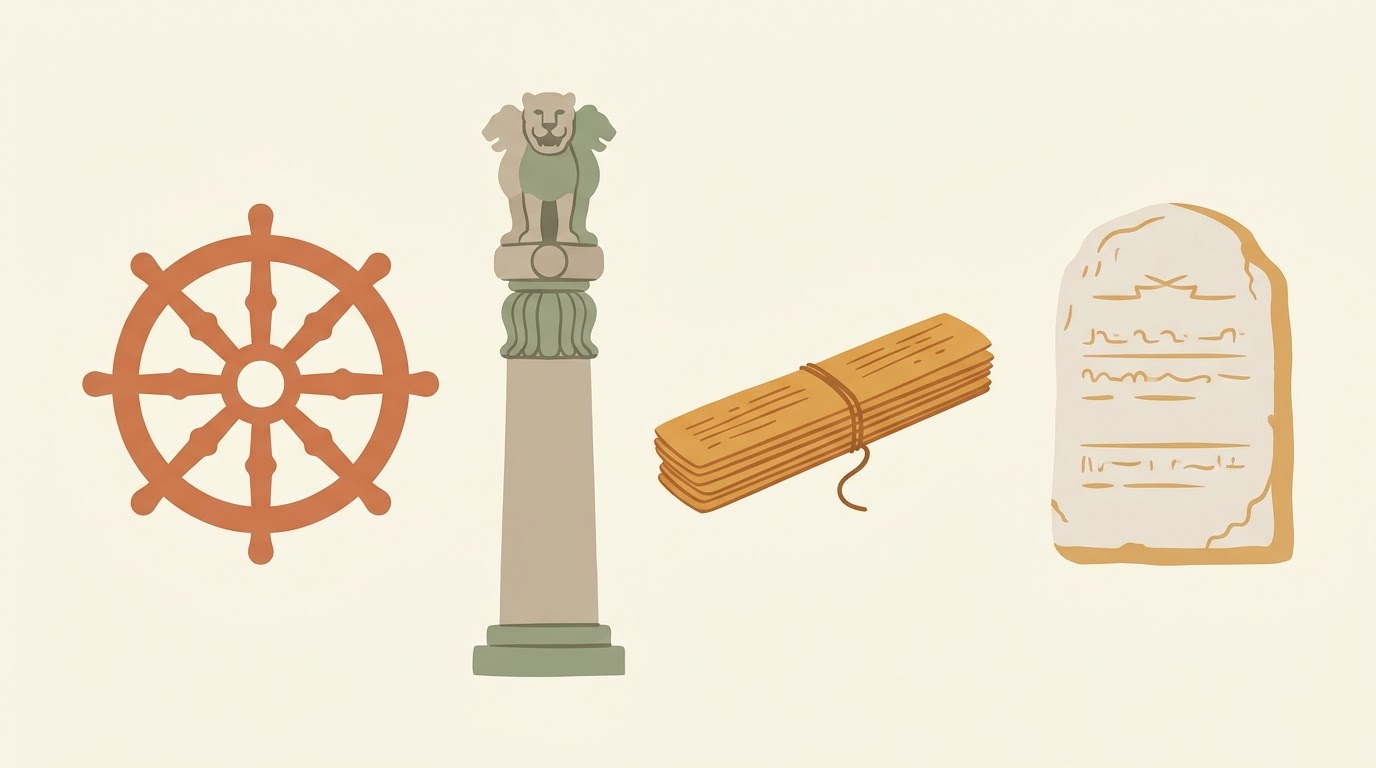
- Historical Context and Ashoka’s Pillars: Held during the reign of Emperor Ashoka, whose grandfather (Chandragupta Maurya) and father (Bindusāra) had fought Alexander the Great’s forces and unified almost all of India (except Tamil Nadu and Kerala in the deep south). Ashoka erected stone pillars chiselled with Dhamma phrases across his empire, which Dhammarato highlights as concrete proof that the Dhamma was written down long before the Fourth Council (and likely even during the Buddha’s lifetime).
- The Catalyst: Ashoka was a “gung-ho patron” who made ordaining as a monk overly easy by providing free robes, bowls, monastery rooms, and medicine. Between 20,000 and 50,000 people ordained for the material benefits, including Hindu swamis and rishis, completely overwhelming the genuine Arahants and teachers (“Ashoka didn’t do Buddhism any favour at all”).
- Proceedings, Entrance Exam, and the Mahāsaṅgha Schism: Convened in Pāṭaliputta (transcribed as “Patagonia”), near Rājagaha (“Rajgiri”), the council instituted an entrance exam: only monks who could answer questions about what the Buddha actually taught were allowed inside. Because Ashoka hosted the council in his home district where the unawakened monks were concentrated, the excluded majority held their own rival assembly called the Mahāsaṅgha (Mahāsāṅghika).
- Outcome and Textual Pollution: While the inner council re-established the authentic Dhamma, Dhammarato identifies the excluded Mahāsaṅgha as the birth of Mahāyāna Buddhism, heavily polluted with Hindu philosophy and magical beliefs. He also notes that new texts (such as the Dhammapada) were composed during this era using magical themes to entice Hindus to convert, making mainstream Buddhism look like “just another form of Hinduism.”
- Sutta and Canonical Cross-References:
- DN 1 (Brahmajālasutta), DN 16, and MN 52 (Aṭṭhakanāgarasutta) notes and commentaries confirm that after the Mauryan dynasty (founded by Chandragupta, Bindusāra, and Ashoka) unified India, lavish state patronage in Pāṭaliputta attracted so many corrupt imposters seeking material profits that the Third Council had to be held to expel them, an event historically linked to placing DN 1 (The Prime Net) at the start of the Dīgha Nikāya to screen out wrong views.
4. The Fourth Council (1st Century BCE)
- Location and Catalyst: Convened in Sri Lanka during a time of “downright warfare” (while Buddhism remained strong in India). Fearing that the authentic teachings were in danger of being wiped out amid the conflict, Sri Lankan monks organised a council to safeguard the canon.
- Proceedings and Outcome: The monks gathered the oral teachings and committed them to writing on palm leaves (or banana leaves). While Sri Lankan tradition claims this was the first time the Dhamma was ever written down, Dhammarato points back to Ashoka’s inscribed pillars 250 years earlier as proof that written Dhamma already existed.
- Sutta and Canonical Cross-References:
- Pali Textual History confirms that the Theravāda Tipiṭaka was transmitted orally by generations of monastic reciters until around 30 BCE (1st century BCE), when it was first written down on palm-leaf manuscripts at the Āluvihāra monastery in Sri Lanka.
5. The Fifth Council (1868 to 1871 CE)
- Location and Catalyst: Held in Mandalay (“Mandala”), Burma, under the patronage of King Mindon (“King Mongdong”) during a decade of widespread global warfare in the 1860s (including British colonial expansion, European wars, and the American Civil War).
- Proceedings and the Marble Tablets: King Mindon collected the entire Pali Tipiṭaka (written in Burmese script) and had it chiselled into more than 750 marble tablets (completed around 1868). From 1868 to 1871, a council of about 500 monks spent two years reviewing the stone carvings, making only one or two minor changes before sanctifying the text. Dhammarato notes that when the British later invaded Mandalay, they looted all the gold and silver (even stealing an Anāgāmi’s golden casket), but left the 750+ marble tablets intact because marble was too heavy to ship back to London.
- Lineage and Regional Context: Dhammarato points out that despite fighting a major war a century earlier, Thailand and Burma were close friends in the 1860s. He connects this period to King Mongkut of Thailand (who spent 24 years as a monk before reigning from ~1850 to 1868 and fathering 47 children, including King Chulalongkorn and Prince Vajirañāṇavarorasa). Through Vajirañāṇavarorasa and his student Somdet Phra Saṅgharāja Pussadeva (“Bhuddhagosa Jarn”) down to Bhikkhu Buddhadāsa, Dhammarato traces his own Thai monastic lineage back to roughly 1804.
6. The Sixth Council (Late 1954 to Early 1956 CE)
- Location, Catalyst, and International Scope: Convened in Rangoon (Yangon), Burma, in response to post-WWII turmoil and ongoing civil war in Burma (which began when the British left in the late 1940s, a conflict Dhammarato notes also drove the invention of the Burmese Vipassanā movement popularised by S.N. Goenka). The council was organised internationally with representatives from eight countries: Sri Lanka, Nepal, India, Burma, Thailand, Laos, Cambodia, and Vietnam.
- Bhikkhu Buddhadāsa’s Role: Bhikkhu Buddhadāsa led the Thai delegation into the council and delivered a keynote address calling on the assembly to preserve the authentic, liberating Dhamma stripped of metaphysical speculation (his untranslated Thai speech is preserved in the Buddhist archives in Bangkok, alongside letters to his teacher at Wat Pathum Wanaram).
- Proceedings and Feats of Memorisation: Modelled as a direct reenactment of the First Council, Mahāsi Sayādaw took on the role of Mahākassapa (asking the questions), and Mingun Sayādaw (“Mungun Savadaw”) took on the role of Ānanda (answering), having memorised and recited the entire Burmese Tipiṭaka from memory in front of the assembly. Meanwhile, delegations from other countries (such as Thailand, represented by master chanters trained at Wat Pho in Bangkok, including a companion of Buddhadāsa who trained Dhammarato’s friend Abbot Mahāomsin of Wat Greensboro) chanted their own national editions of the Pali Tipiṭaka in separate rooms.
- Core Controversy and Outcome: Just as Ānanda struggled with the belief in “continuing existence” prior to the First Council, the number one controversy at the Sixth Council remained rebirth and continuing existence, which ended with no resolution because participants refused to let go of their cherished beliefs.
Synthesis: Continuing Existence and the Four Imponderables
Dhammarato ties the entire chronology of the Six Councils back to why the controversy over rebirth and kamma is a distraction from the Buddha’s core teaching (dukkha and dukkha-nirodha, or “don’t worry, be happy”):
- Reincarnation vs. Rebirth: He distinguishes the Hindu view of reincarnation (that a permanent “you” or consciousness returns after death, which the Buddha rebuked in MN 38) from the modern Buddhist rationalisation of rebirth (that “something” inherits kamma, but it isn’t “you”). Dhammarato points out that if the future inheritor is not you, and you are constantly changing (anicca), then you right now are not even the inheritor of the old you from the past, making past and future lives completely irrelevant to present practice.
- The Four Imponderables (Acinteyya Sutta, AN 4.77): In answering questions at the end of the talk, Dhammarato explains why pondering these metaphysical questions only creates dissatisfaction:
- The results of Kamma (actions): You cannot know the full future value or complex causal chain of an action in advance; the result in the present moment is what determines whether an action was workable or not.
- The extent of the mind of a Buddha: An ordinary, dissatisfied mind cannot conceptualise what liberation is like without experiencing it directly.
- The extent of Jhāna (the human mind): You cannot know the full capacity of the human mind or meditative states through speculation, only through direct experience.
- The origin and future of the world: Nobody knows how the universe started (such as the Big Bang) or what will happen in the future (such as whether there will be a Seventh Council), because we are simply “plopped into the middle of it, right here, right now.”
Views: 4